Want more strategies like this?
Join our free newsletter to get weekly Band 9 frameworks delivered straight to your inbox.
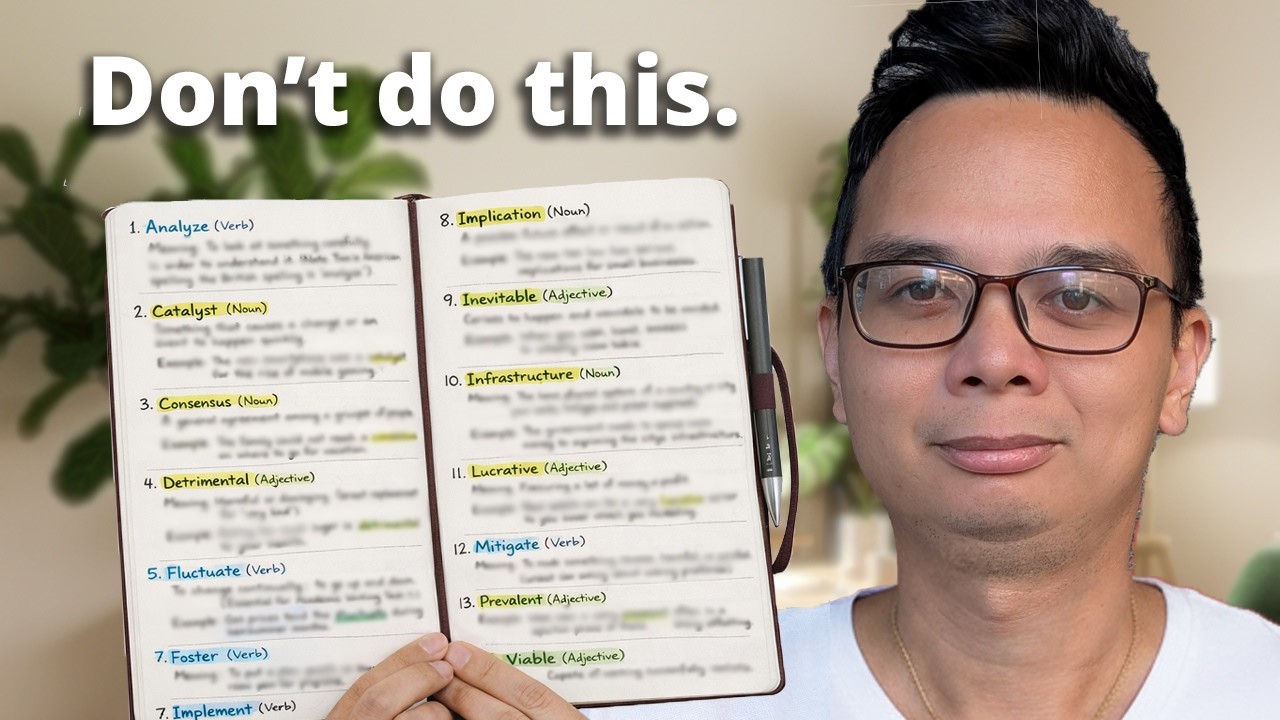
You’ve been studying vocabulary lists for months. You’ve memorized synonyms for good, bad, and important. And yet your IELTS Speaking score has barely moved.
Here’s the uncomfortable truth: the very thing you think is going to save your score might be what’s holding it back. Vocabulary obsession is one of the most common — and most damaging — traps I see intermediate and advanced learners fall into. I know this because I’ve analyzed the recordings of students who are stuck, and the pattern is almost always the same.
I’m Matt. I recently sat the IELTS exam myself and scored a Band 9 for IELTS Speaking, including a Band 9 across all four individual criteria. In this guide, I’ll show you the exact marking math that vocabulary-obsessed learners ignore, and I’ll give you a clear, two-step strategy to fix your score.
The Student Who Was Convinced His Words Were the Problem
A student reached out to me recently. He’d been stuck at a Band 6 for months and was convinced his only path to a Band 7.5 was to expand his vocabulary. He told me he wasn’t good at synonyms, and he believed this was the core reason he wasn’t progressing.
So I did what I always do. I looked at the data. I listened to his recordings.
And I found the real problem immediately — it wasn’t his vocabulary at all.
The Hidden Issue: Speed and Unnatural Pauses
When I analyzed his speech patterns, I discovered two critical issues:
- He was speaking at around 100 words per minute — far too slow for natural conversation.
- He had 11 unnatural pauses for every 100 words he spoke.
These weren’t pauses to breathe. They weren’t pauses to gather a thought or idea. They were pauses to hunt for a fancy word.
He would start a sentence, stop completely, silently search his mental dictionary for the perfect replacement for good, eventually land on the word exemplary — and then continue his sentence after an awkward gap. While exemplary is certainly a richer word than good, the pause that preceded it was silently damaging his score in ways he hadn’t considered.
The Marking Math You’re Probably Ignoring
The IELTS Speaking test is divided into four equally weighted criteria:
- Fluency & Coherence — 25%
- Lexical Resource (Vocabulary) — 25%
- Grammatical Range & Accuracy — 25%
- Pronunciation — 25%
Here’s the critical insight: every criterion carries exactly the same weight.
When vocabulary-obsessed learners pause and hesitate to insert a more complex word, they are making a losing trade. They are sacrificing points from their guaranteed Fluency & Coherence score in exchange for a potential marginal gain in their Lexical Resource score.
Think about the logic for a moment. You’re trading a 25% pillar of your score — one you could easily protect — for a tiny possible boost in another. That’s not a smart strategy. That’s a guaranteed loss.
The brutal truth: Simple English spoken smoothly can often score much higher than complex English spoken hesitantly.
You Probably Already Have Enough Vocabulary
If you’re at an intermediate or advanced level of English, there’s a strong chance you already possess the vocabulary needed to reach a Band 7. The problem isn’t your word bank. The problem is your access to it.
You’re blocking your own access by filtering and second-guessing yourself in real time. Every time you pause mid-sentence to swap out a word for something “better,” you’re demonstrating to the examiner that you lack the fluency of a natural speaker.
Native speakers don’t hunt through a mental thesaurus mid-conversation. They trust the first word that comes to mind and keep the rhythm of speech going. They prioritize the flow of the conversation over the sophistication of individual words.
Step 1: Prioritize Speed First
Your immediate target is to increase your speaking pace. Stop editing yourself silently while you speak. Trust the first word that comes into your mind and say it.
If you can’t instantly recall the word elated, just say happy. Don’t spend two seconds in silence hunting for a synonym. Those two seconds of silence signal to the examiner that you’re translating in your head — and that’s one of the clearest signs of limited fluency.
The Target Speaking Range
| Speed | What It Signals |
|---|---|
| Below 100 wpm | Slow, laboured, and unnatural |
| 120–150 wpm | Natural, fluent conversation — the sweet spot |
| Above 160 wpm | Risk of losing clarity and pronunciation quality |
Aim to consistently hit that 120–150 words per minute range. That’s the zone where natural English conversation lives. Once you can hit it reliably, you protect your full 25% Fluency & Coherence score.
Don’t Forget Coherence
Speaking faster is only half the equation. Fluency and Coherence are scored together, which means you also need to connect your ideas logically. Speaking quickly while rambling or jumping between unrelated points won’t help you. Aim for fast and logical — not just fast.
Step 2: Layer Vocabulary On Top of Speed — Never Instead of It
Once you’ve reached that fluency sweet spot consistently, then you can begin to layer in more advanced vocabulary. But the key principle never changes: vocabulary complements your speed, it never replaces it.
When you’ve stopped hunting for words and your pace feels natural, something important happens — complex vocabulary starts to flow naturally too. When you use a word like exemplary at a natural speaking rhythm, you deliver it with the cadence of a high-level speaker. That’s when it genuinely impresses an examiner, because it sounds effortless rather than forced.
How I Tracked My Own Fluency
As an introvert, I naturally gravitate toward precise language. I like to feel confident that the words I’m using accurately reflect what I mean. So when I was preparing for my Band 9, this exact trap was something I had to consciously fight.
To manage it, I built a tool for myself called the SpeakPrac app. It allowed me to:
- Record my speech during practice sessions
- Transcribe what I said automatically
- Measure my words per minute and identify where I was slowing down
- Spot unnatural pauses and understand when they were occurring
Seeing the data made it impossible to ignore. There were sessions where my pace dropped well below the target range and I could see clearly that I needed to increase my speed. Having that metric in front of me turned a vague feeling (“I think I’m speaking slowly”) into an actionable insight (“I’m at 95 wpm — I need to increase to 130 wpm”).
The Takeaway
Stop treating vocabulary as the single most important factor in your IELTS Speaking score. It’s worth exactly 25% — no more and no less — and obsessing over it at the cost of your fluency is one of the most common ways high-potential candidates leave points on the table.
Here’s the two-step sequence:
- Fix your speed first. Aim for 120–150 wpm. Trust your first word. Stop hunting.
- Add vocabulary second. Once your fluency is automatic, layer in richer language naturally and confidently.
The goal isn’t to sound like a thesaurus. The goal is to sound like a fluent, articulate person — and that starts with never letting the search for a better word break your flow.
Ready to take your speaking to the next level?
Apply today's tips in the SpeakPrac app and get instant AI feedback on all 4 IELTS criteria. Or master the fundamentals with my complete, free video course.