Want more strategies like this?
Join our free newsletter to get weekly Band 9 frameworks delivered straight to your inbox.
Most IELTS students work incredibly hard. They practice every day, answer question after question, and still plateau at Band 6 or 7. The problem usually isn’t effort — it’s structure. Without a clear framework for each part of the test, even fluent speakers leave points on the table.
I recently sat the IELTS Speaking test myself and scored a Band 9 — a perfect score across all four criteria. The single biggest factor wasn’t my vocabulary or my accent. It was having a deliberate, repeatable structure for every question type. In this guide, I’m going to give you the three frameworks I used for Parts 1, 2, and 3, so you can stop improvising and start scoring.
Part 1: The A.R.E. Framework™
Part 1 is the warm-up phase. The examiner asks simple, everyday questions about your home, your job, and your hobbies. It feels casual — and that casualness is exactly what trips people up.
The Two Classic Mistakes
The Dead End is when you answer too briefly and too fast:
“Do you like music?” “Yes, I do.”
This gives the examiner almost nothing to grade. It reads as a Band 5 answer or lower.
The Rambler is the opposite problem — you launch into a five-minute monologue on the history of music theory. This is also penalized because it’s not what Part 1 expects.
What you need is the Goldilocks zone: around 20 seconds per answer. Not too short, not too long.
How the A.R.E. Framework™ Works
A — Answer the question directly.
R — Reason why.
E — Example or explanation to back it up.
Here’s what that sounds like in practice:
“Do you like music?”
Answer: Absolutely. I’d say I’m a real music enthusiast.
Reason: It’s my go-to after a long, stressful day.
Example: Just yesterday, I had my earphones on the whole commute, listening to indie pop tracks I recently discovered.
To a listener, this sounds completely natural. Underneath it is a precise analytical structure that prevents you from both rambling and giving dead-end answers. That combination is what earns high marks for Fluency and Coherence.
Part 2: The Topic Diamond™
Part 2 is where most students feel real panic. You receive a cue card with a main topic and a few bullet points, then have one minute to prepare before speaking for two full minutes — entirely on your own.
Why the Checklist Approach Fails
The instinct most students have is to treat the bullet points like a checklist: answer point one, point two, point three, done. The result? You run dry at around 45 seconds, and the remaining 75 seconds become an excruciating silence that tanks your Fluency score.
Those bullet points are suggestions, not a script.
How the Topic Diamond™ Works
Imagine a diamond shape with four points:
- Left — The Past: Background, history, origin
- Top — The Present: Current state, what it looks like now
- Right — The Future: Plans, expectations, what comes next
- Bottom — Opinion & Feelings: Why it matters to you personally
The topic sits at the core. By rotating through these four angles, you can speak about any object, person, or place for a full two minutes without going blank.
Example: Cue card topic is “a bicycle.”
| Diamond Point | What to Say |
|---|---|
| Past | When did you first get it? Who gave it to you? |
| Present | What does it look like now? How often do you use it? |
| Future | Do you plan to keep it? Would you upgrade? |
| Opinion | Why does this object matter to you? |
Following this structure gives the examiner a logical, coherent journey through your answer — exactly what the Coherence & Cohesion criterion rewards.
A Built-in Grammar Bonus
One underrated benefit of the Topic Diamond™: it forces you to use different tenses. Talking about the past naturally produces past simple and past continuous. The present triggers present perfect. The future unlocks conditionals. Without any extra effort, your Grammatical Range and Accuracy score gets a boost because you’re demonstrating tense variety in a totally organic way.
Practice with Exam Conditions
Knowing a framework is one thing — executing it under timed pressure is another. When I was preparing, I built the SpeakPrac app specifically so I could practice the Topic Diamond™ under real exam conditions: a visible timer, a two-minute limit, and instant AI feedback on fluency metrics. Thousands of students now use it as their daily practice tool.
Part 3: The I.D.E.A. Framework™
Part 3 is the deep-dive discussion. The examiner shifts from personal questions to abstract, society-level questions:
“Do you think modern technology makes people more isolated?”
A Band 6 student gives a simple opinion: “Yes, because people just look at their phones all day.”
A Band 9 student builds a sophisticated argument. That’s exactly what the I.D.E.A. Framework™ is designed to do.
How the I.D.E.A. Framework™ Works
I — Idea: State your position clearly.
D — Develop: Expand on the idea with reasoning.
E — Example: Support it with a specific example or evidence.
A — Alternative: Introduce a counterpoint or nuance.
Here’s what a full I.D.E.A. answer sounds like:
Idea: In most cases, I do believe that technology has deepened the divide between people.
Develop: Social media especially can create an illusion of connection. People can have millions of followers online, but still feel profoundly alone in their day-to-day lives.
Example: Research shows that heavy social media users report significantly higher levels of loneliness than those who spend more time in face-to-face social settings.
Alternative: On the flip side, though, technology has genuinely brought certain communities together — online support groups for people struggling with mental health issues being a strong example.
Why the “Alternative” Is Your Secret Weapon
The A in I.D.E.A. is what separates a good answer from a Band 9 answer. Introducing a counterpoint demonstrates critical thinking — one of the clearest signals to an examiner that they’re listening to a high-level speaker.
It also forces you to use complex linking language naturally:
- “However…”
- “On the other hand…”
- “On the flip side, though…”
- “That said…”
These connectives lift your Lexical Resource and Coherence scores simultaneously without you having to think about them separately.
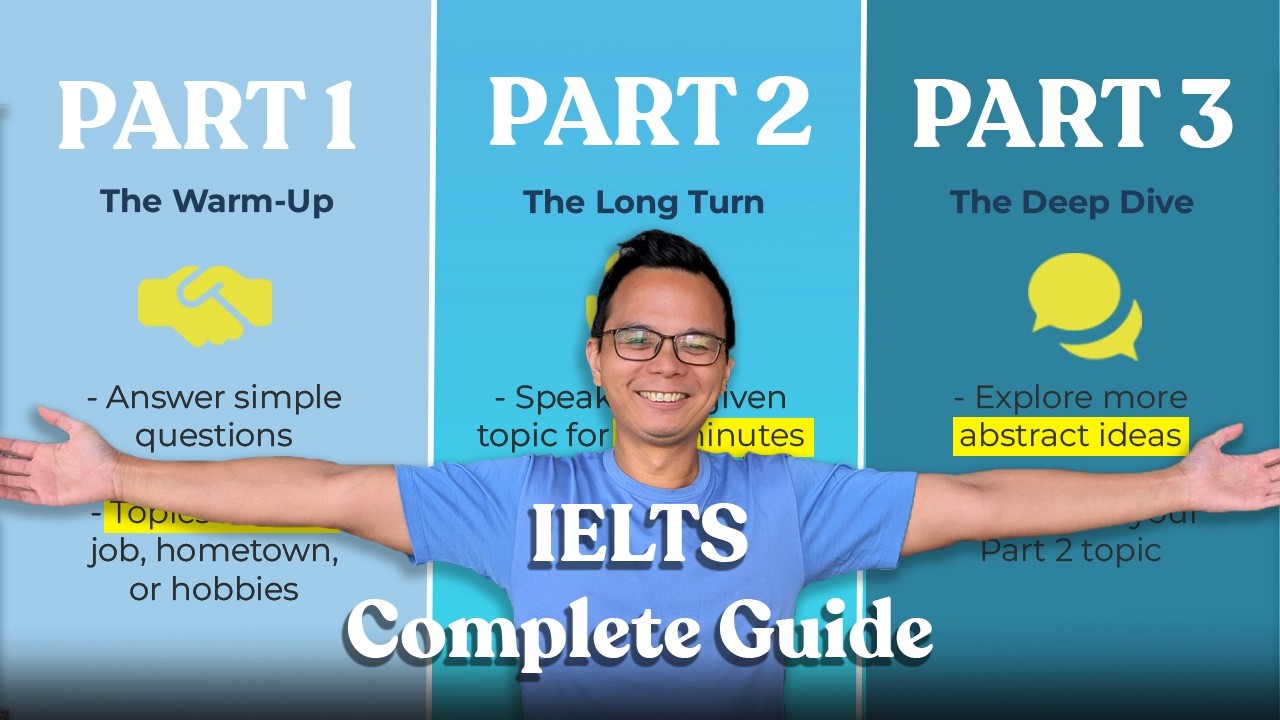
How All Three Frameworks Work Together
Here’s the big picture view:
| Part | Framework | Core Goal |
|---|---|---|
| Part 1 | A.R.E. Framework™ | Hit the Goldilocks zone — not too short, not too long |
| Part 2 | Topic Diamond™ | Speak for two minutes with coherence and tense variety |
| Part 3 | I.D.E.A. Framework™ | Demonstrate critical thinking and sophisticated argument |
When you internalize all three, something important happens: you stop thinking about structure. That frees up mental bandwidth to focus on vocabulary choices, pronunciation, and staying calm under pressure. Structure becomes automatic, and your best language rises to the surface.
The Next Step
These frameworks are powerful, but they only work if you actually practice them out loud. Reading about the Topic Diamond™ is not the same as executing it under a two-minute timer while an examiner watches you.
Use the SpeakPrac app to drill all three frameworks in exam-like conditions — timed, recorded, and with AI feedback so you can hear exactly where your fluency drops or your structure breaks down.
Structure gives you confidence. Confidence gives you Band 9.
Ready to take your speaking to the next level?
Apply today's tips in the SpeakPrac app and get instant AI feedback on all 4 IELTS criteria. Or master the fundamentals with my complete, free video course.